
Opening a brokerage account makes it possible to buy shares. The next step is deciding whether you understand the company well enough to invest in it.
This checklist is not designed to produce a Buy, Hold, or Sell score. It is designed to help you slow down, ask useful questions, and identify what you still need to investigate.
You do not need every answer to be positive. The purpose is to understand what you are buying, which risks you are accepting, and what you should continue to monitor.
Five areas to check before you buy
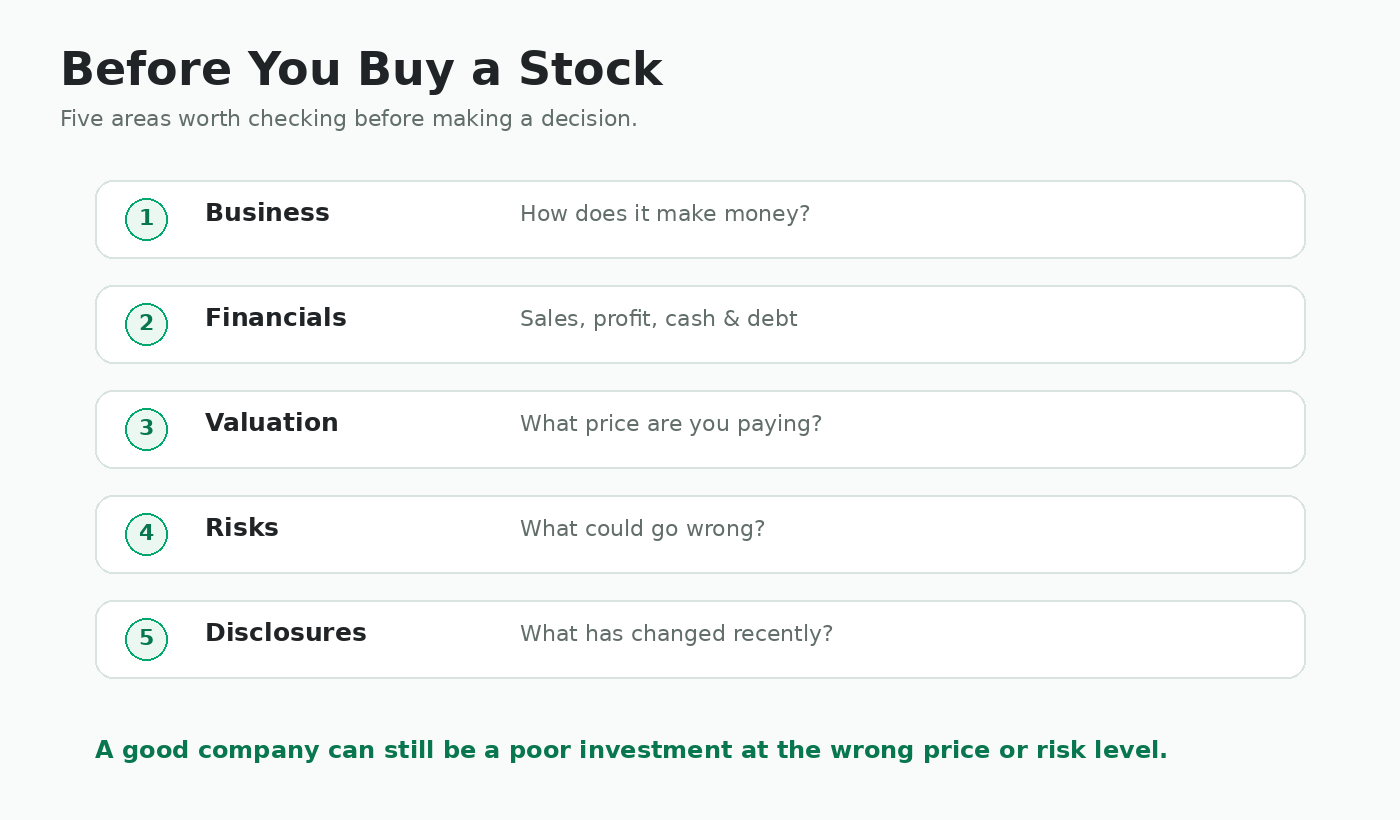
1. Do I understand what the company actually does?
Before looking at price charts or recent market moves, make sure you understand the business.
Try to explain the company in one or two simple sentences. What does it sell? Who are its customers? Where does it operate? Which business segments are most important?
If you cannot explain how the company works in plain language, you may not yet understand enough about what you are buying.
Questions to ask:
- What products or services does the company provide?
- Who pays the company?
- Which business segment produces most of its revenue or profit?
- Does the company depend heavily on one customer, product, project, or market?
2. How does the company make money?
Knowing what a company does is not always the same as understanding how it earns money.
A property company, for example, may earn from residential sales, office leasing, shopping malls, hotels, or property management. A bank may earn from interest on loans, fees, trading income, and other financial services.
Ask what needs to keep happening for the company to remain profitable.
Look for:
- Main sources of revenue
- Main sources of profit
- Recurring versus one-time income
- Important costs that can rise or fall
- Whether one business area supports weaker parts of the company
3. Are revenue and profit moving in the right direction?
Review several reporting periods instead of relying on a single quarter.
Revenue growth can be encouraging, but higher sales do not automatically mean the business is becoming more profitable. Costs, interest expense, taxes, or unusual items may move differently.
Check:
- Revenue growth or decline
- Operating income
- Net income
- Gross, operating, and net margins
- Earnings per share
Also ask why the figures changed. Growth caused by stronger operations is different from a temporary gain caused by selling property or another one-time event.
4. Does reported profit turn into cash?
Accounting profit and cash flow are related, but they are not the same thing.
A company can report a profit while collecting little cash from customers, building inventory, or using cash for other working-capital needs.
Check:
- Is operating cash flow positive?
- Is operating cash flow reasonably consistent with net income over time?
- Are receivables growing much faster than sales?
- Is inventory rising while sales weaken?
One unusual quarter may have a reasonable explanation. Repeatedly weak operating cash flow compared with profit deserves closer investigation.
5. How much debt does the company have?
Debt is not automatically bad. Companies borrow to build projects, acquire businesses, expand operations, or manage normal financing needs.
The more useful question is whether the business can comfortably support its debt.
Check:
- Total debt and how it has changed
- Debt due within the next year
- Cash available
- Operating cash flow
- Interest expense
- What the borrowed money is being used for
Appropriate debt levels differ by industry. A utility, property developer, bank, and asset-light service company should not automatically be judged using the same debt level.
6. Is the company issuing more shares?
When a company issues additional shares, existing shareholders may own a smaller percentage of the company unless they also participate.
This is called dilution.
Look for:
- Rights offerings
- Private placements
- Employee or management share plans
- Conversion of preferred shares or debt
- Other increases in outstanding shares
Issuing shares is not automatically negative. The important question is what shareholders receive in exchange for the dilution. Capital used for productive expansion can have a very different effect from repeated issuance needed to fund continuing losses.
7. Does the company pay dividends, and are they sustainable?
If dividends are part of your reason for investing, look beyond the current dividend yield.
A high historical yield does not guarantee that the same dividend will be paid again.
Check:
- Dividend history
- Whether payments are regular or special
- Profit available to support dividends
- Operating cash flow
- Debt and other financing needs
- Major expansion projects that may require cash
A company that does not pay dividends is not automatically a poor investment. It may be reinvesting cash into expansion or other opportunities.
8. What are the main business risks?
Every investment has risks. The goal is not to find a company with no risk, but to understand which events could materially hurt the business.
Depending on the company, important risks may include:
- Commodity-price changes
- Interest rates
- Foreign-exchange movements
- Regulatory changes
- Customer concentration
- Heavy debt
- Project delays
- Competition
- Economic weakness
- Dependence on one product, market, or major shareholder
Ask yourself whether you understand these risks and whether you are comfortable accepting them.
9. What do the latest reports and disclosures tell me?
A company profile explains the business broadly. Recent disclosures tell you what has changed.
Before investing, review recent company information such as:
- The latest quarterly or annual report
- Material press releases
- Dividend declarations
- Capital raising
- Acquisitions or disposals
- Significant borrowing
- Insider transactions
- Other major corporate actions
A useful question is: Has anything happened recently that changes the reason I am interested in this company?
10. What am I paying for the shares?
A good company is not automatically a good investment at every price.
Valuation helps you understand what the market is asking you to pay relative to the company's earnings, assets, dividends, or other relevant measures.
Depending on the type of company, investors may look at measures such as:
- Price-to-earnings ratio, or P/E
- Price-to-book ratio
- Dividend yield
- Valuation compared with the company's own history
- Valuation compared with similar businesses
No single valuation ratio tells you whether a stock will rise or fall. Ratios are tools for understanding what investors are currently paying and what expectations may already be reflected in the share price.
Write down why you are interested
Before investing, try to complete one simple sentence:
I am interested in this company because...
Then write down three things:
- What I believe: What do I think the business can achieve?
- What I will watch: Which financial or business indicators matter most?
- What would make me reconsider: Which change would weaken my original investment case?
This creates a basic investment thesis. It can help you judge future developments using the reasons you originally invested instead of reacting only to daily share-price movements.
Simple example: forming an investment thesis
Imagine you are researching a fictional bank.
Why I am interested: The bank has been growing loans and deposits while remaining profitable.
What I will watch: Loan growth, bad loans, funding costs, net interest margin, capital levels, and cash dividends.
What would make me reconsider: Credit losses rise substantially, profitability weakens for several periods, or the balance sheet becomes materially weaker.
This does not predict whether the share price will rise. It simply makes the investor's reasoning explicit and gives them something concrete to monitor.
Before You Buy checklist
- □ I can explain what the company does.
- □ I understand how the company earns money.
- □ I checked recent revenue and profit trends.
- □ I checked operating cash flow.
- □ I understand the company's debt position.
- □ I checked whether the number of shares is increasing.
- □ If dividends matter to me, I checked whether they appear sustainable.
- □ I understand the company's main business risks.
- □ I read the latest quarterly or annual report.
- □ I checked recent company disclosures.
- □ I considered what I am paying for the shares.
- □ I can explain why I am interested in the company.
- □ I know what developments I want to monitor after investing.
The checklist is not a score
You do not need every answer to be positive.
Strong companies can have weaknesses, and companies going through difficult periods can improve. A checklist cannot tell you whether a share price will rise or whether an investment is suitable for you.
The purpose is to understand what you are buying, which risks you are accepting, and what evidence you should continue to monitor.
StockBayan can help organize company information and explain disclosures, but the investment decision remains yours.