
A company disclosure tells the market that something has happened or is expected to happen. The first task is not to decide whether it is good or bad. The first task is to understand exactly what changed.
From disclosure to understanding
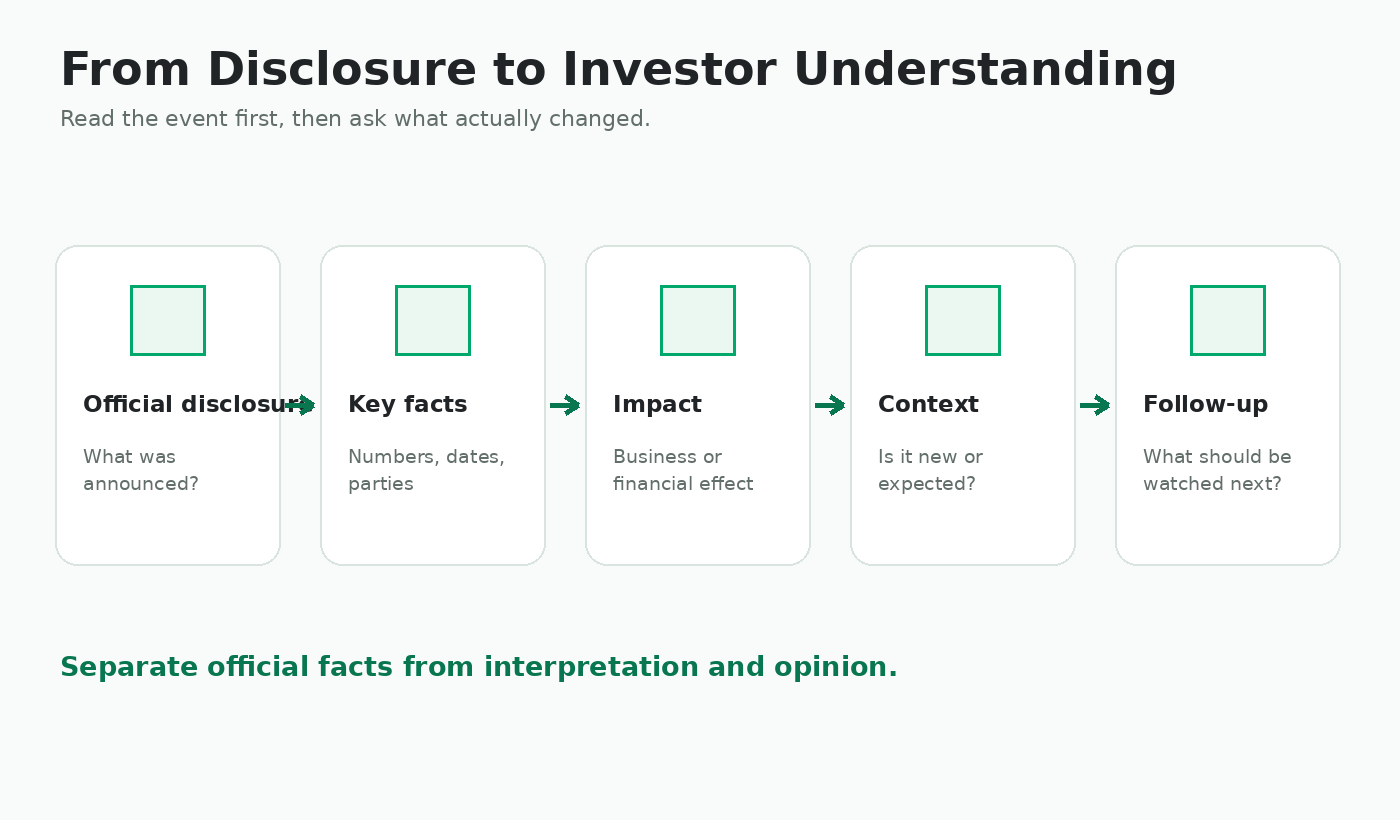
What is a company disclosure?
A company disclosure is an official announcement released by a listed company to inform investors and the market about important information.
A disclosure may describe something that has already happened, something that has been approved, or something that the company expects to happen later.
Examples include:
- A new business contract
- A dividend declaration
- Quarterly financial results
- A loan or financing agreement
- The purchase or sale of a business or asset
- A change in directors or senior management
- An insider buying or selling shares
- A rights offering or other share issuance
Disclosures help reduce the information gap between the company and the investing public. They allow investors to review important developments using information released by the company itself.
However, a disclosure does not automatically explain whether the share price should rise or fall. Investors must still understand the details, size, timing, risks, and possible financial effects.
First ask: What happened?
Begin by identifying the main event in one clear sentence.
Try to complete this statement:
The company announced that it...
For example:
- ...signed a new supply contract.
- ...declared a cash dividend.
- ...borrowed money from a bank.
- ...purchased another company.
- ...issued additional shares.
- ...appointed a new chief executive officer.
If you cannot explain the event simply, read the title, opening paragraph, and important facts again before forming an opinion.
Do not begin with whether the announcement sounds positive or negative. First establish what actually changed.
When does it take effect?
The announcement date and the effective date may be different.
A company may announce a contract today, but the contract may begin next year. A dividend may be declared today, while payment may occur several weeks later. A proposed acquisition may still require regulatory approval or other conditions.
Look for dates connected to:
- Approval
- Signing
- Completion
- Start of operations
- Subscription periods
- Ex-dividend and record dates
- Dividend payment
- Share listing
- Regulatory decisions
Dates help you distinguish between an immediate event, a future plan, and a transaction that is not yet certain.
How large or important is it?
A disclosure may sound impressive but still be small compared with the company's existing business.
Look for numbers that help measure its importance:
- Contract value
- Purchase price
- Loan amount
- Number of new shares
- Dividend per share
- Expected revenue contribution
- Project capacity
- Percentage ownership acquired or sold
- Effect on debt or cash
Then compare those numbers with the company's size.
Simple example
A company announces a ₱100 million contract.
For a small company with annual revenue of ₱300 million, the contract may be significant.
For a large company with annual revenue of ₱100 billion, the same contract may have only a limited effect.
The size of the headline number matters less than its size relative to the company.
Who is affected?
Identify the people, businesses, or shareholders affected by the announcement.
Ask whether the disclosure affects:
- All shareholders
- Only holders of a particular share class
- Existing shareholders who may participate in an offering
- A specific subsidiary or business segment
- Customers or suppliers
- Employees or management
- Lenders
- A related party
This is especially important for dividends, rights offerings, mergers, tender offers, related-party transactions, and changes in share ownership.
Do not assume that every shareholder receives the same benefit or faces the same effect.
Is it recurring or one-time?
Investors should distinguish between events that may continue and events that happen only once.
Possible recurring developments:
- Ongoing sales from a new customer contract
- Regular rental income from a completed property
- Recurring interest expense from a new loan
- Continuing revenue from a newly acquired business
Possible one-time developments:
- Profit from selling land
- An insurance payment
- A special dividend
- A restructuring charge
- A one-time tax benefit
- A gain from selling a subsidiary
A one-time gain may improve reported profit for one period without improving the company's normal operations.
A recurring development may be more important over the long term, but investors should still consider costs, risks, and whether management can deliver the expected results.
What should investors watch next?
Many disclosures are the beginning of a process rather than the final result.
After understanding the announcement, identify the next event that could confirm whether the plan is progressing.
Examples include:
- Completion of an acquisition
- Regulatory approval
- Financial closing of a project
- Start of construction
- Beginning of commercial operations
- Release of offer terms
- End of a subscription period
- Listing of newly issued shares
- Recognition of revenue in future reports
- Actual dividend payment
A useful disclosure summary should not only explain what happened. It should also help the reader identify what evidence to look for next.
What information is still missing?
Sometimes an announcement provides only part of the information needed to judge its financial importance.
Details that may still be missing include:
- The exact contract value
- Expected profit margin
- Funding source
- Interest rate
- Completion date
- Regulatory conditions
- Expected revenue or profit contribution
- Number and price of new shares
- Possible effect on existing shareholders
- Risks that could delay or prevent completion
Missing information does not automatically mean something is wrong. It means the investor should avoid making a precise conclusion that the disclosure does not support.
Watch for later disclosures, financial reports, presentations, or official clarifications that provide the missing details.
Common types of company disclosures
Different disclosure types should be read with different questions in mind.
Press releases
Press releases explain company developments in a reader-friendly way. Check whether the announcement includes measurable facts, dates, and financial details.
Quarterly reports
Quarterly reports show revenue, profit, cash flow, debt, and other financial information for the reporting period. Compare the correct periods and look for one-time items.
Dividend declarations
Check the dividend per share, declaration date, ex-dividend date, record date, payment date, and whether the dividend is regular or special.
Insider transactions
These show reported purchases or sales of company shares by directors, officers, or other covered insiders. An insider transaction is useful information, but it is not proof that the share price will move in the same direction.
Share offerings
Check the number of new shares, offer price, purpose, timetable, and possible dilution of existing shareholders.
Acquisitions and disposals
Look at the purchase or sale price, funding source, assets involved, expected contribution, and whether approvals are still required.
New projects and contracts
Check the project value, expected duration, customer, start date, costs, and whether the amount is significant relative to the company.
Loans and financing
Look for the amount borrowed, lender, maturity, interest cost, collateral, and intended use of funds.
Management changes
Understand who is leaving or joining, when the change takes effect, and whether the company explains the reason.
Related-party transactions
Review who the related party is, why the transaction is being made, how the price was determined, and whether independent approval was required.
Trading suspensions and resumptions
Read the stated reason carefully. A suspension may allow important information to be released fairly before trading resumes.
Example: Reading a new contract announcement
Announcement: A listed construction company states that it has received a notice of award for a ₱2.5 billion infrastructure project.
A beginner may immediately think:
“A ₱2.5 billion contract must be very positive.”
A more careful reading asks:
- Has the final contract already been signed?
- When will construction begin?
- How long will the project take?
- How much revenue will be recognized each year?
- What costs will the company incur?
- Does the company need additional borrowing or equipment?
- How large is ₱2.5 billion compared with its existing order book and annual revenue?
- Are there conditions that must be completed first?
Possible interpretation: The award may support future revenue, but the full contract value is not the same as immediate revenue or profit. The financial effect depends on timing, costs, margins, execution, and final contract conditions.
Be careful with headline language
Company announcements naturally present developments from the company's perspective.
Words such as major, strategic, transformational, leading, and significant may describe management's view, but investors should still look for supporting numbers and details.
Ask:
- What measurable fact supports the description?
- Is the transaction completed or only proposed?
- Does the announcement discuss costs as well as benefits?
- Are the expected results guaranteed or only targets?
- What risks or conditions are mentioned?
Positive language is not a substitute for financial evidence.
Always check the official source
StockBayan makes disclosures easier to read by presenting summaries, extracted facts, and educational explanations.
However, summaries can omit details or contain errors. Always open the official disclosure when the information may affect an investment decision.
Use the official document to verify:
- Exact amounts
- Dates
- Conditions
- Definitions
- Attachments
- Management statements
- Legal and financial details
StockBayan should help you understand the disclosure faster, but it should not replace the original source.
Company disclosure checklist
- □ What exactly happened?
- □ Has it already happened, or is it still proposed?
- □ When does it take effect?
- □ How large is it compared with the company?
- □ Who is affected?
- □ Is the effect recurring or one-time?
- □ Does it affect revenue, profit, cash, debt, or the number of shares?
- □ Are regulatory approvals or other conditions still required?
- □ What important information is still missing?
- □ What should investors watch next?
- □ Have I checked the official disclosure?
Understand first, interpret second
The purpose of reading a disclosure is not to react as quickly as possible. It is to understand the event accurately.
Begin with the facts:
- What changed?
- When does it matter?
- How large is it?
- Who is affected?
- What remains uncertain?
Only after answering those questions should you consider whether the development may strengthen or weaken the company over time.
A clear understanding of the disclosure is more useful than a quick opinion based only on the headline.