
Dividends are payments made by a company to eligible shareholders. The amount matters, but the dates and the sustainability of the dividend matter too.
Dividend timeline
What is a dividend?
A dividend is a distribution made by a company to eligible shareholders.
A company may distribute part of its profit or available retained earnings instead of keeping all of the money inside the business.
For ordinary investors, the most common type is a cash dividend paid for each share owned.
For example, if a company declares a cash dividend of ₱1.50 per share and you own 1,000 eligible shares, your gross dividend is:
1,000 shares × ₱1.50 = ₱1,500
The amount actually received may be lower after applicable withholding tax or account-related charges.
A dividend is not guaranteed. The company's board must declare it, and future dividends may be increased, reduced, postponed, or discontinued.
Why do companies pay dividends?
A company may pay dividends when it has earnings or available cash that it does not immediately need for operations, debt repayment, acquisitions, or expansion.
Dividends may allow shareholders to receive part of the value created by the business without selling their shares.
However, paying a dividend also means cash leaves the company.
Investors should ask:
- Is the company consistently profitable?
- Does it generate enough operating cash flow?
- Does it still have enough cash for normal operations?
- Is debt manageable?
- Does the company have large upcoming projects or obligations?
- Is the dividend funded by normal business performance or by a one-time event?
A dividend can be attractive, but it should not weaken the company's ability to operate or invest in its future.
Regular and special dividends
Regular dividend
A regular dividend is part of a company's usual dividend pattern. It may be paid annually, semi-annually, quarterly, or according to another schedule.
A regular dividend is still not guaranteed. The amount can change when profit, cash flow, debt, or business conditions change.
Special dividend
A special dividend is an additional or unusual distribution that may result from:
- A strong cash position
- The sale of an asset or business
- An unusually profitable period
- Excess capital
- A one-time corporate event
A special dividend should not automatically be treated as recurring income.
When comparing dividend history, separate normal dividends from special dividends so you do not overestimate what may be paid in future years.
Understand the important dividend dates
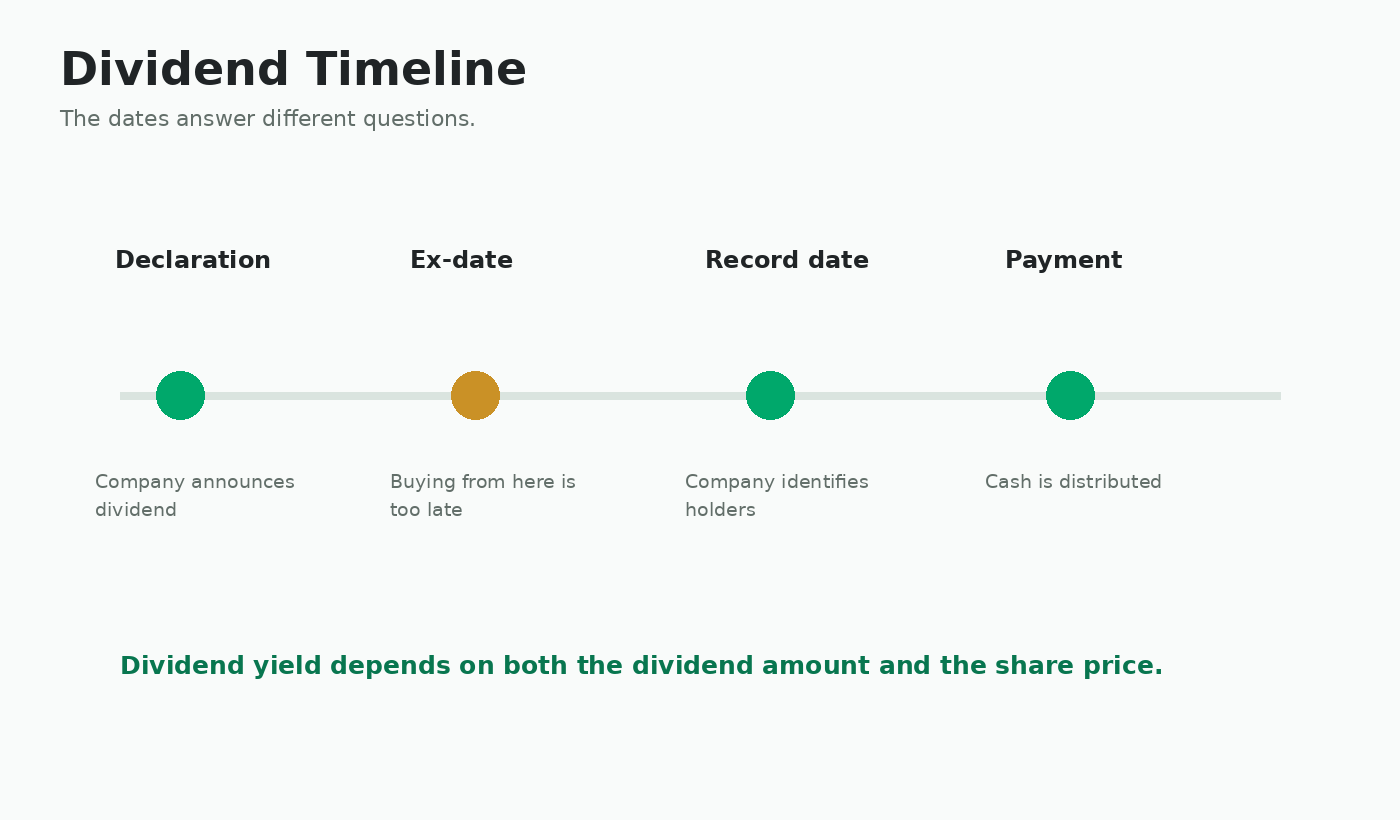
A dividend announcement normally includes several dates. Each date answers a different question.
Declaration date
The date when the company's board formally announces or approves the dividend.
Ex-dividend date
The date from which the shares trade without the right to receive the declared dividend.
An investor who buys on or after the ex-dividend date will generally not receive that dividend. An investor normally needs to own the shares before the ex-dividend date, subject to the applicable market settlement rules.
Record date
The date when the company checks its shareholder records to determine who is entitled to the dividend.
Payment date
The date when the dividend is scheduled to be paid to eligible shareholders.
Do not confuse the declaration date with the payment date. A dividend may be announced weeks before the money is distributed.
Example: Following the dividend timeline
Imagine a company announces the following:
- Declaration date: August 5
- Ex-dividend date: August 18
- Record date: August 19
- Payment date: September 4
An investor who wants to qualify normally needs to purchase the shares before August 18, subject to market settlement rules.
Buying on August 18 or later would generally be too late for that dividend.
Eligible shareholders are identified using the record date, and payment is scheduled for September 4.
Always verify the exact dates in the official company disclosure because dividend timetables can be amended.
What may happen to the share price on the ex-dividend date?
On the ex-dividend date, new buyers no longer receive the declared dividend.
Because part of the company's value is being distributed to shareholders, the share price may adjust downward by an amount related to the dividend.
However, the actual market movement may be larger or smaller because the price is also affected by:
- General market conditions
- New company information
- Investor demand
- Trading volume
- Changes in expectations
A dividend is not free money. The investor receives cash, but the market price may adjust when the entitlement separates from the shares.
Dividend per share
Dividend per share is the amount declared for each eligible share.
Gross dividend = Number of eligible shares × Dividend per share
Simple example
- Shares owned: 10,000
- Dividend per share: ₱2.30
Gross dividend:
10,000 × ₱2.30 = ₱23,000
The gross amount is calculated before applicable tax and charges.
Check the type of security carefully. A company may declare different dividends for common shares and different preferred-share series.
Understand withholding tax
Dividend payments may be subject to withholding tax depending on the investor, the company, and applicable tax rules.
For an illustrative Philippine individual investor who is a citizen or resident alien receiving a cash dividend from a domestic corporation, a 10% final withholding-tax estimate may apply.
Illustrative example
- Gross dividend: ₱23,000
- Estimated withholding tax at 10%: ₱2,300
- Estimated net dividend: ₱20,700
Important: Actual tax treatment can differ for corporations, non-residents, tax-exempt accounts, special entities, treaty situations, and other investor types.
The StockBayan calculator should keep the tax rate editable and clearly label the result as an estimate rather than a tax determination.
Understand dividend yield
Dividend yield compares the annual dividend per share with the current share price.
Dividend yield = Annual dividend per share ÷ Share price
Simple example
- Annual dividend per share: ₱2.00
- Share price: ₱40.00
Dividend yield:
₱2.00 ÷ ₱40.00 = 5%
Dividend yield changes when the dividend or share price changes.
A historical yield is based on dividends already paid. A forward yield may use expected future dividends, which are not guaranteed.
Always check how the yield was calculated before comparing companies.
Why a high dividend yield is not always positive
A very high dividend yield can look attractive, but it may be a warning sign.
The yield may be high because:
- The share price has fallen sharply
- The dividend included a special one-time payment
- The market expects the dividend to be reduced
- Profit or cash flow is weakening
- The company is paying more than it can reasonably sustain
Simple example
A company paid ₱4.00 per share during the last year. Its share price later fell from ₱80 to ₱40.
The historical yield now appears to be 10%.
However, the falling price may reflect weaker business conditions, and the company may not repeat the same dividend.
A high yield should lead to more investigation, not an automatic decision to buy.
Is the dividend sustainable?
Dividend sustainability means whether the company may reasonably continue paying the dividend without damaging its finances.
Review:
- Net income
- Operating cash flow
- Free cash flow
- Cash balance
- Total debt
- Interest expense
- Capital-expenditure plans
- Dividend history
- Management's stated dividend policy
A profitable company can still have weak cash flow. A company with strong cash flow can still face major debt repayments or expansion spending.
The dividend should therefore be reviewed together with the income statement, balance sheet, and cash-flow statement.
Understand the payout ratio
The payout ratio compares dividends with company earnings.
Payout ratio = Total dividends ÷ Net income
Simple example
- Net income: ₱1.0 billion
- Total dividends: ₱400 million
Payout ratio: 40%
This means the company distributed 40% of its profit and retained the remaining amount.
A high payout ratio is not automatically bad, and a low payout ratio is not automatically good.
Mature businesses may distribute a larger portion of earnings. Growing companies may retain more cash for expansion.
Be cautious when dividends repeatedly exceed profit or available cash flow without a clear explanation.
Cash dividends and stock dividends
Cash dividend
A cash dividend pays money to eligible shareholders.
Stock dividend
A stock dividend distributes additional shares instead of cash.
A stock dividend increases the number of shares held, but it does not automatically create additional economic value. The company's total value is divided among a larger number of shares.
Simple example
An investor owns 1,000 shares and receives a 10% stock dividend.
The investor receives 100 additional shares and then owns 1,100 shares.
The market price per share may adjust because more shares are outstanding.
Always check whether the announcement is a cash dividend, stock dividend, property dividend, or another type of distribution.
Common and preferred-share dividends
A company may have common shares and one or more preferred-share series.
Preferred shares may have dividend terms linked to a stated rate, issue price, or specific schedule.
Common-share dividends are usually more dependent on company performance and board approval.
Before using a dividend announcement, verify:
- The exact security symbol
- The share class or preferred-share series
- The dividend rate or amount
- The relevant ex-dividend, record, and payment dates
Do not assume that a dividend declared for one security applies to every share issued by the company.
Why dividends may be reduced or discontinued
A company may reduce, suspend, or discontinue dividends because of:
- Lower profit
- Weak operating cash flow
- Heavy debt repayments
- Large capital-expenditure requirements
- An acquisition
- Regulatory restrictions
- Economic uncertainty
- A need to preserve cash
A dividend reduction can disappoint investors, but retaining cash may sometimes protect the company or fund valuable projects.
Investors should judge both the immediate loss of income and the reason management gives for keeping the cash.
Worked example: Looking beyond the dividend amount
Imagine two companies both declare a dividend of ₱2.00 per share.
Company A
- Share price: ₱40
- Dividend yield: 5%
- Profit is stable
- Operating cash flow is positive
- Debt is manageable
- The dividend has been paid regularly
Company B
- Share price: ₱20
- Dividend yield: 10%
- Profit declined sharply
- Operating cash flow is negative
- Debt increased
- The dividend included a one-time asset-sale gain
Company B has the higher yield, but its dividend may be less sustainable.
The example does not prove that Company A is a better investment. It shows why the dividend amount and yield should be reviewed together with profit, cash flow, debt, and the source of the payment.
Use the dividend calculator
The StockBayan dividend calculator can estimate the payment using:
- Number of shares owned
- Dividend per share
- Editable withholding-tax rate
- Optional fees
The calculator should display:
- Gross dividend
- Estimated withholding tax
- Other fees
- Estimated net dividend
The result is an estimate. Eligibility depends on the official dividend timetable, and actual tax or account charges may differ.
Always check the official dividend disclosure
StockBayan can extract the dividend amount and important dates, but investors should verify the official company disclosure.
Confirm:
- Type of dividend
- Security or share class
- Dividend per share or dividend rate
- Ex-dividend date
- Record date
- Payment date
- Source of payment
- Whether the announcement was amended
A later amended disclosure may change an amount, date, or other important condition.
Dividend checklist
- □ Is this a cash, stock, special, or another type of dividend?
- □ Which security or share class receives it?
- □ What is the dividend per share?
- □ What is the ex-dividend date?
- □ What is the record date?
- □ What is the payment date?
- □ Do I own eligible shares before the ex-dividend date?
- □ What is the estimated gross payment?
- □ What tax rate or charges may apply to me?
- □ Is the yield based on regular or special dividends?
- □ Is the dividend supported by profit and operating cash flow?
- □ Is debt manageable after the payment?
- □ Is the company funding major projects or obligations?
- □ Has the company paid similar dividends consistently?
- □ Have I checked the official disclosure for amendments?
Look beyond the yield
A dividend can provide useful income, but the highest yield is not automatically the best dividend.
A careful investor considers:
- The amount per share
- The important dates
- Applicable tax and charges
- Whether the payment is regular or special
- The company's profit and cash flow
- Debt and future spending needs
- Whether the dividend can reasonably continue
The goal is not only to calculate the next payment. It is to understand where the dividend comes from and whether the company can support it over time.