
Before reading financial reports or company disclosures, it helps to understand what a share represents, why companies list on the Philippine Stock Exchange, and how risk and potential return are connected.
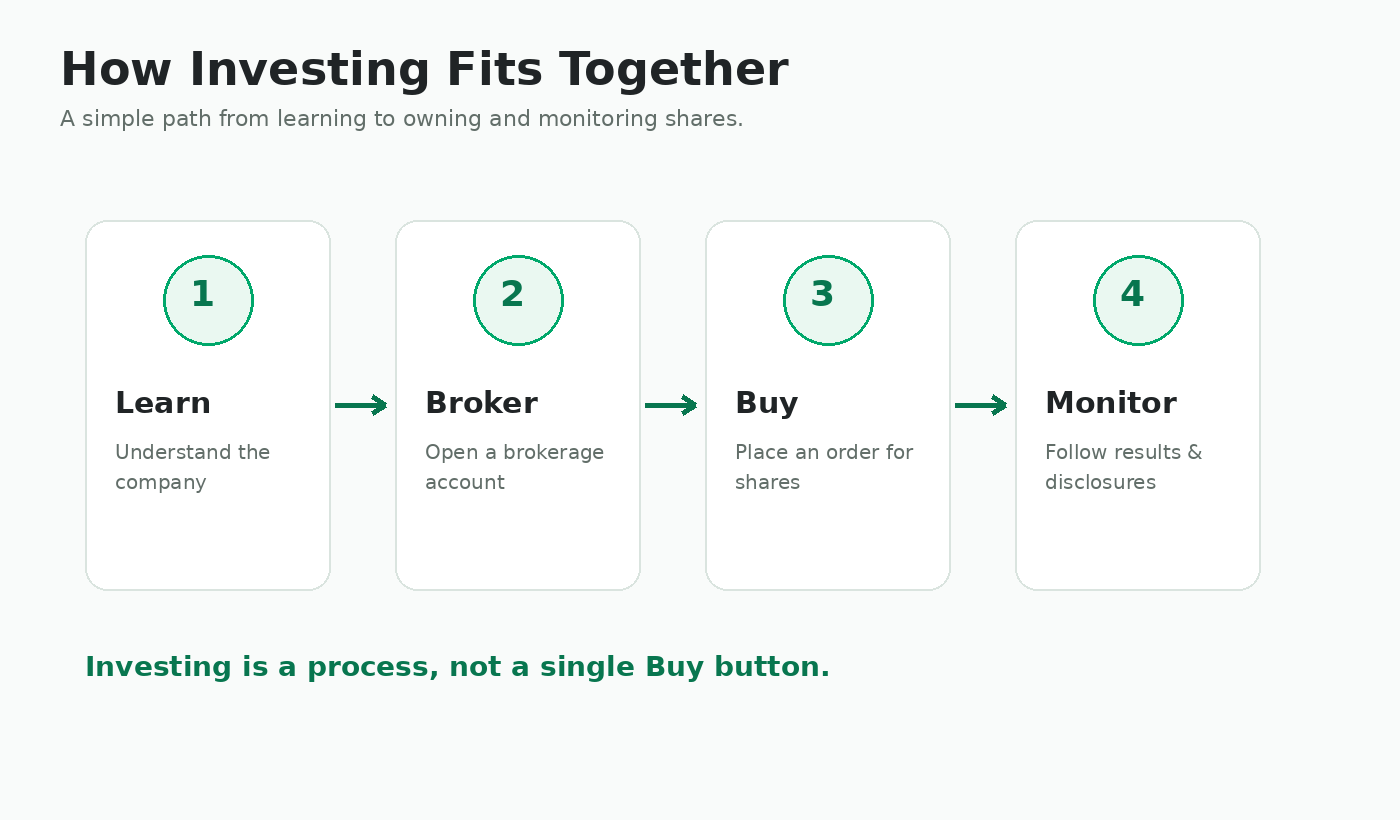
How investing fits together
What does a share represent?
A share represents a small ownership interest in a company.
When you buy shares of a listed company, you become one of its shareholders. The percentage of the company you own will usually be very small, but your shares still represent a real ownership interest.
As a shareholder, you may benefit when the company grows, becomes more profitable, or distributes part of its earnings as dividends.
However, owning shares does not guarantee that you will earn money. The value of your investment can rise or fall.
Simple example
Imagine a company has 100 million outstanding shares and you own 10,000 shares.
Your percentage ownership:
10,000 ÷ 100,000,000 = 0.01%
You own a small portion of the company, but your ownership percentage can change if the company issues additional shares.
Why do companies list on the PSE?
The Philippine Stock Exchange, or PSE, provides a regulated market where shares of listed companies can be bought and sold.
A company may list its shares to raise capital from investors.
The money raised can be used for purposes such as:
- Expanding operations
- Building new facilities
- Funding projects
- Acquiring another business
- Reducing debt
- Developing new products
- Providing existing shareholders with a way to sell part of their ownership
In exchange for access to public investors, listed companies must follow disclosure and reporting requirements.
This is why investors can access quarterly reports, annual reports, dividend announcements, ownership disclosures, and information about important company events.
How can investors earn from shares?
There are two common ways investors may earn from owning shares.
Price appreciation
Price appreciation happens when the market price of a share increases.
Example:
- You purchase 1,000 shares at ₱20 per share.
- Your total investment is ₱20,000.
- Later, the share price increases to ₱25.
- The market value becomes ₱25,000.
Your unrealized gain is ₱5,000 before fees and taxes.
The gain remains unrealized until you sell the shares. The price could still rise or fall before you sell.
Dividends
A company may distribute part of its earnings or available cash to shareholders as dividends.
Example:
- You own 1,000 shares.
- The company declares a cash dividend of ₱1.50 per share.
- Your gross dividend is ₱1,500.
Applicable withholding tax and other charges may reduce the amount you receive.
Companies are not required to pay dividends. Dividends may be increased, reduced, postponed, or discontinued.
Potential return and risk are connected
Investments with the possibility of higher returns normally also involve uncertainty and risk.
A company may perform better than expected, but it may also face:
- Lower sales
- Higher costs
- Increased competition
- Heavy debt
- Regulatory changes
- Economic weakness
- Project delays
- Management problems
- Natural disasters
- Foreign-exchange movements
- Changes in investor confidence
The share price can also change even when the company has not released new information.
A falling price does not always mean the company is failing, and a rising price does not always mean the company is financially strong.
This is why price movement should be considered together with company disclosures, financial performance, debt, cash flow, and business risks.
Why diversification matters
Diversification means spreading investments across several companies, sectors, or types of assets instead of placing all available money into one investment.
If all your money is invested in one company, a serious problem affecting that company could have a large effect on your entire portfolio.
Diversification cannot remove all risk, but it can reduce the effect of one company or sector performing poorly.
Simple example
An investor places all available funds into one property company. The property sector later experiences weak demand and rising financing costs. The investor’s entire portfolio may be affected.
Another investor holds companies from several sectors, such as banking, utilities, consumer products, and telecommunications. A problem affecting one sector may have a smaller effect on the overall portfolio.
Diversification should not mean buying many companies without understanding them. Each investment should still be reviewed carefully.
Investing and short-term trading are different
Investing usually focuses on the company’s long-term business performance.
An investor may examine:
- Revenue and profit
- Cash flow
- Debt
- Competitive position
- Dividends
- Management
- Long-term growth opportunities
- Business risks
Short-term trading focuses more heavily on shorter price movements and market timing.
A trader may hold shares for days, hours, or even minutes, while a long-term investor may hold shares for several years.
Neither approach removes risk. However, beginners should understand which approach they are following and avoid switching strategies only because the share price moved unexpectedly.
Use a licensed broker
Shares listed on the PSE are normally purchased through an authorized stockbroker.
A broker provides access to the market and maintains the investor’s trading account.
Before opening an account:
- Verify that the broker is properly licensed
- Use the broker’s official website or application
- Review the broker’s fees and account requirements
- Protect your password and one-time codes
- Never allow strangers to control your account
- Be cautious of people claiming they can trade guaranteed profits on your behalf
StockBayan provides educational information but is not a stockbroker and does not execute trades.
Do not normally invest emergency money
Money needed for essential expenses should not normally be exposed to stock-market risk.
Emergency funds may be needed for:
- Medical expenses
- Housing
- Food
- Education
- Family emergencies
- Loss of employment
- Urgent repairs
Share prices can fall, and lightly traded shares may be difficult to sell quickly at the expected price.
Investing money that may be needed soon can force an investor to sell at an unfavorable time.
Be cautious with borrowed money
Borrowing money to invest increases risk.
The value of the investment may fall, but the loan, interest, and repayment obligations remain.
Example:
An investor borrows ₱100,000 to buy shares. The shares later decline by 30%. The investment is now worth approximately ₱70,000, but the investor may still owe the full loan amount plus interest.
Beginners should be especially cautious with margin accounts, leverage, personal loans, credit cards, and other forms of borrowed money used for investing.
Start by understanding, not predicting
New investors often feel pressure to identify the next rapidly rising stock.
A more useful starting point is learning to answer basic questions:
- What does the company do?
- How does it earn money?
- Is revenue growing?
- Is the company profitable?
- Does it generate cash?
- How much debt does it have?
- Is it issuing additional shares?
- Does it pay dividends?
- What risks does management mention?
- What important information has the company recently disclosed?
The purpose of the StockBayan Investor Guide is to help you understand these questions before making your own investment decisions.
Beginner checklist
- □ I understand what a share represents.
- □ I know that returns are not guaranteed.
- □ I understand the difference between price gains and dividends.
- □ I know that higher potential returns normally involve risk.
- □ I avoid placing all my money into one company.
- □ I understand whether I am investing or short-term trading.
- □ I use a properly licensed broker.
- □ I protect my password and one-time codes.
- □ I do not normally invest emergency funds.
- □ I am cautious about investing borrowed money.
- □ I review official company disclosures before making decisions.