
Strong uptrends rarely move straight upward. They often advance, pull back, stabilize and then attempt another move higher.
The challenge is distinguishing a normal pause from a real breakdown in trend structure.
See a pullback inside an uptrend
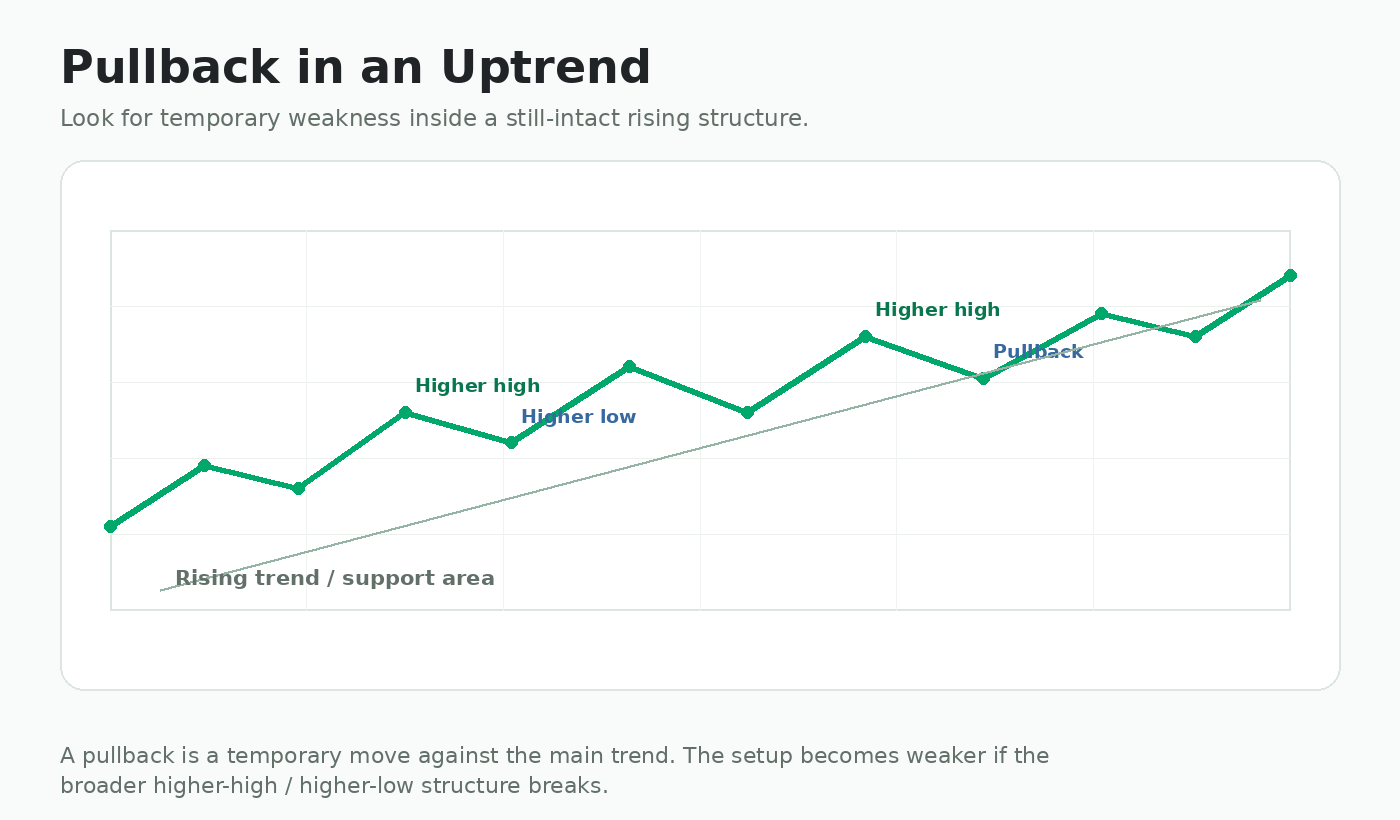
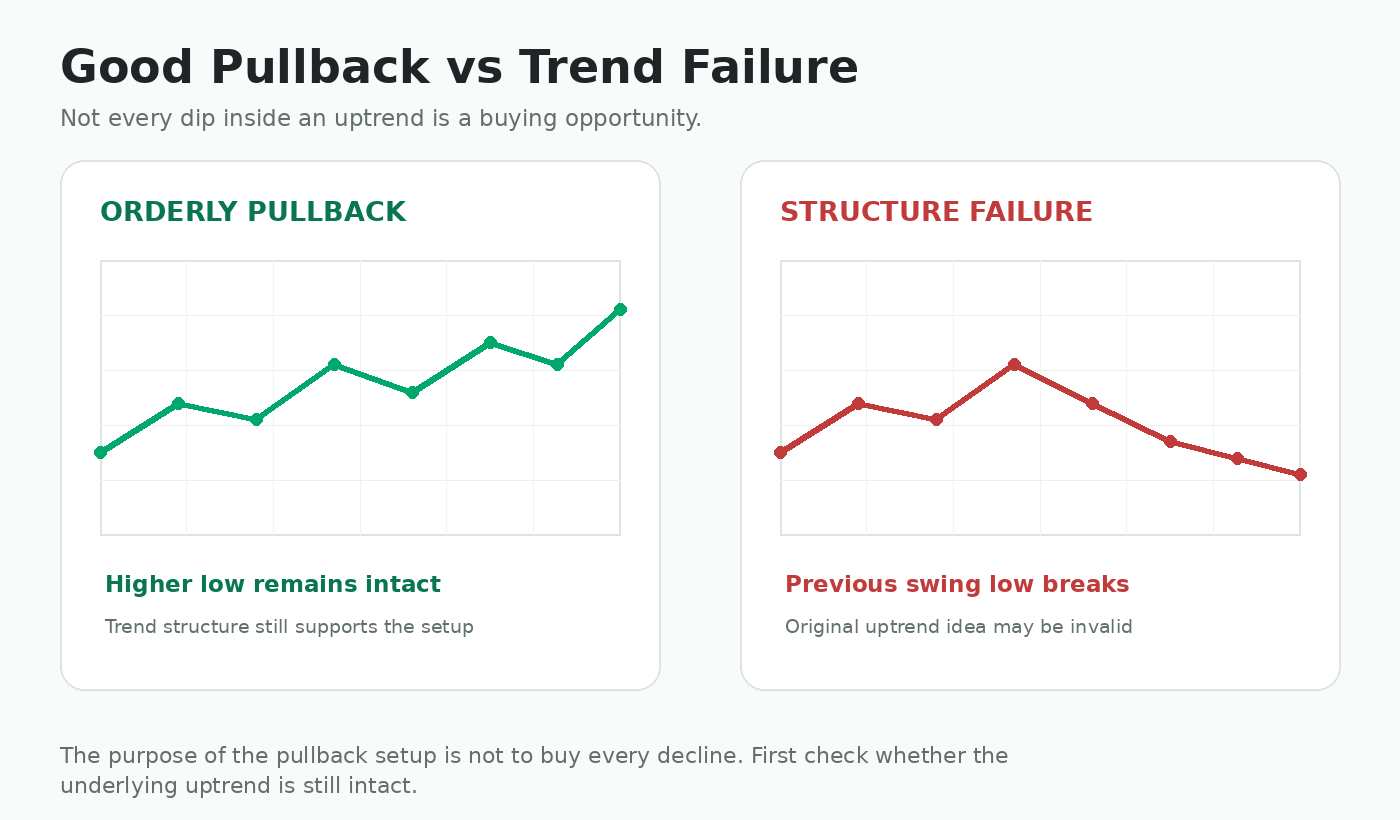
The goal is not to buy every dip. First check whether the higher-high / higher-low structure remains intact and whether the pullback is orderly.
What is a pullback?
A pullback is a temporary move against the direction of a larger trend. In an uptrend, price rises, pauses or declines for a period, then may attempt to continue higher.
The purpose of the strategy is not to buy every falling price. It is to look for temporary weakness while the underlying uptrend remains intact.
Why pullbacks happen
Even strong uptrends rarely move straight upward. Pullbacks can happen because:
- Short-term traders take profits.
- Price reaches temporary resistance.
- The market pauses after a fast move.
- Buyers wait for a better entry price.
- Broader market weakness temporarily affects the stock.
First confirm the uptrend
Before looking for a pullback entry, confirm that the larger structure still resembles an uptrend.
If price breaks the structure decisively, the setup may no longer be a pullback inside an uptrend. It may be the start of a larger trend change.
Where a pullback may find support
Traders often watch areas where buyers may become interested again:
- Previous breakout areas.
- Prior resistance that may now act as support.
- Recent swing lows.
- Well-tested support zones.
- Trend areas used consistently by the trader's strategy.
No level is guaranteed to hold. The purpose is to identify a logical area and then watch price behaviour there.
What can confirmation look like?
Instead of buying simply because price has fallen, watch for evidence that selling pressure is slowing and buyers are returning.
- Lower-price rejection or long lower wicks.
- A strong bullish close after the pullback.
- Volume expanding as price turns upward.
- A higher low forming above the previous major swing low.
- Price reclaiming a short-term level lost during the pullback.
Risk management
A pullback trade becomes invalid when the price action no longer supports the original uptrend idea.
Depending on the setup, invalidation might be below the pullback low, below an important support zone or below a larger swing low. The stop should be tied to chart structure rather than an arbitrary distance.
Common pullback mistakes
- Buying every decline because the stock used to be in an uptrend.
- Entering before the pullback shows any sign of stabilizing.
- Ignoring a break of the previous major swing low.
- Buying directly into nearby resistance.
- Ignoring declining liquidity or unusually heavy selling volume.
- Averaging down repeatedly after the original setup has already failed.