
Good trading is not built on being right every time. It is built on controlling what happens when you are wrong.
Risk management turns an uncertain market idea into a defined decision: where you enter, where the idea is invalid, how much you can lose and how large the position should be.
Make the risk visible before you enter
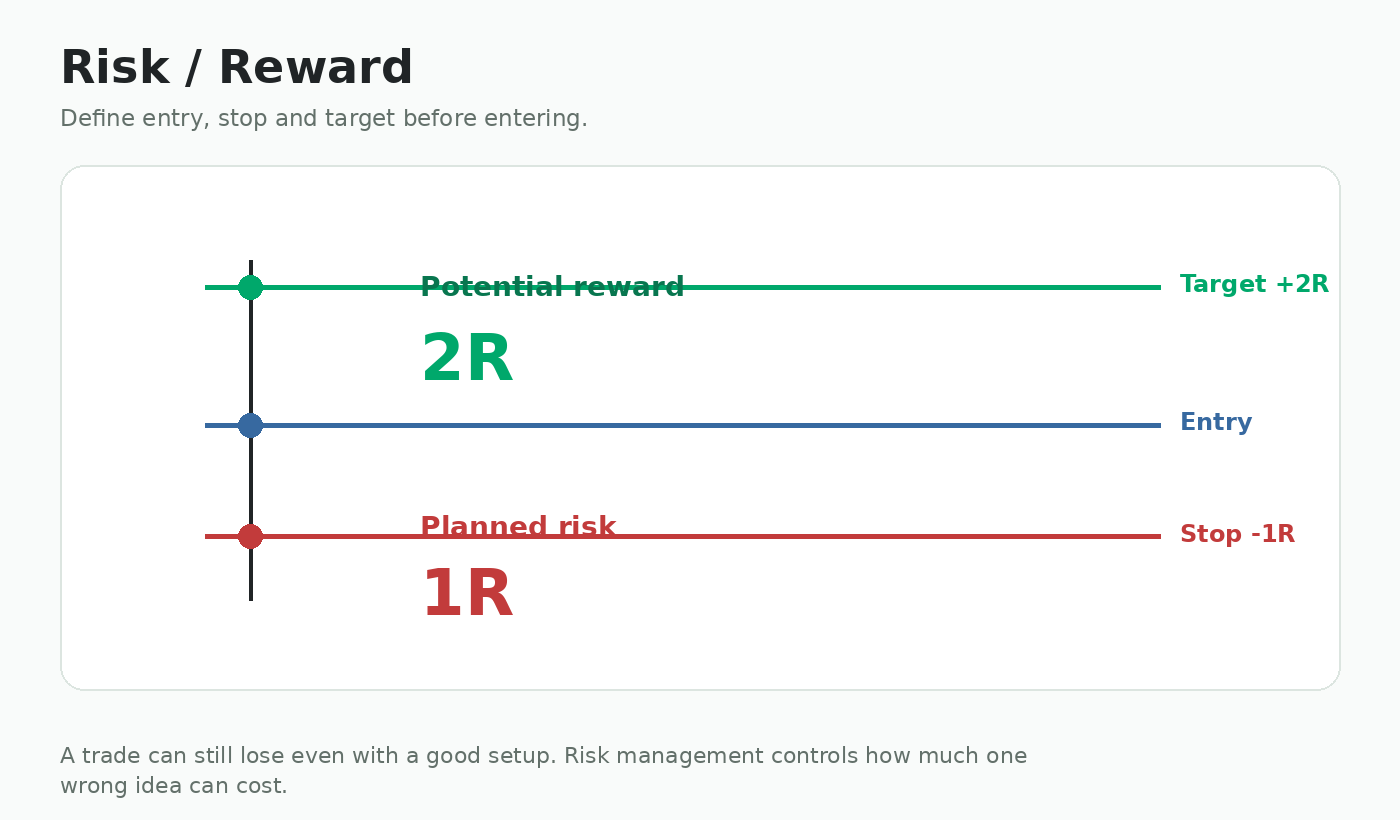
Risk/reward and position sizing are easier to understand when you can see how entry, stop, target and position size fit together.
Why risk management comes first
No trading setup works every time. Risk management exists because losing trades are a normal part of trading.
The goal is not to avoid every loss. The goal is to prevent one trade, one mistake or one emotional decision from doing serious damage to your account.
Define risk before entry
Before entering, identify the price level that would tell you the original trade idea is no longer valid.
Position sizing
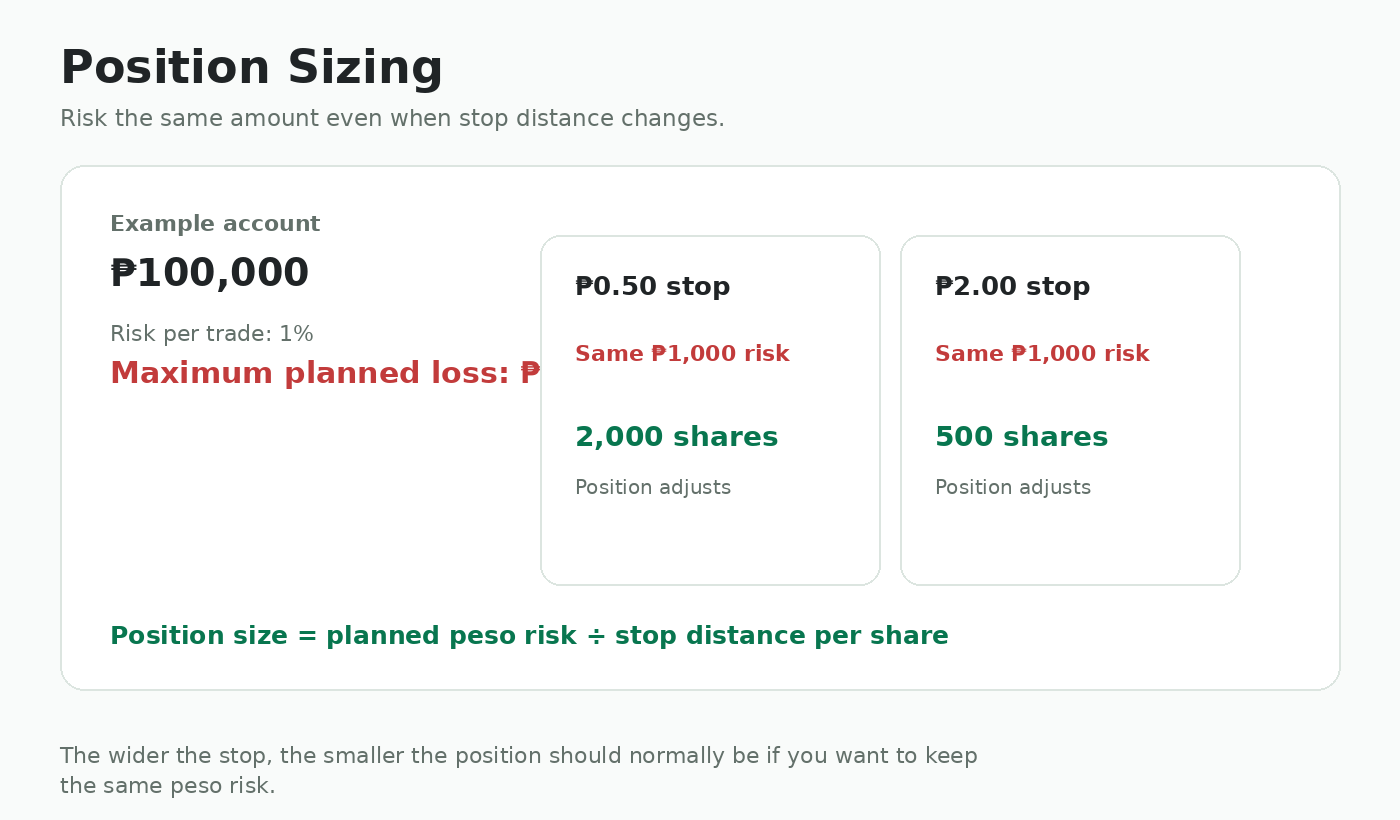
Position sizing connects your stop distance with the amount of money you are willing to risk.
A simple educational formula is:
Example: If your planned maximum loss is ₱1,000 and the difference between entry and stop is ₱0.50 per share, the mathematical position size would be 2,000 shares before considering board lots, fees, slippage or available liquidity.
This is an example of the calculation, not a recommendation for how much any investor should risk.
Percentage risk is a framework, not a rule
Some traders define a small percentage of account value as the maximum planned loss on one trade. You may hear examples such as 1%, but there is no universal percentage that is correct for everyone.
The useful concept is consistency: decide the maximum loss before entering instead of allowing the market to decide it for you after the trade goes wrong.
Risk / reward
Risk/reward compares how much you could lose if the setup fails with how much you might reasonably gain if it works.
A good-looking risk/reward number does not make a bad setup good. The target must still make sense based on price structure, resistance, liquidity and realistic market behaviour.
Stops and invalidation
A stop should represent the point where the original reason for the trade no longer makes sense.
- Do not place a stop randomly just because a percentage feels comfortable.
- Do not move a stop farther away simply because you do not want to take the loss.
- Allow for normal volatility so the stop is not sitting inside ordinary market noise.
- Check liquidity because actual execution can differ from the intended stop price.
Managing winning and losing trades
Risk management continues after entry.
The exact management method can vary by strategy, but it should be decided deliberately rather than emotionally.